
The Truths Young Homebuyers Need To Hear

For many young or first-time homebuyers, purchasing a home can feel intimidating. A recent survey shows some homebuyers ages 25 to 40 may be unsure about the homebuying process and what they can afford. It found:
- “1 in 4 underestimated their buying potential by $150k or more”
- “1 in 4 underestimated the increase in value by $100k or more”
- “47% don’t know what a good interest rate is”
Because they feel uncertain, many young homebuyers have given up on their search, or worse, they’ve decided homebuying isn’t for them and never started on their journey to begin with.
If you’re interested in buying but aren’t sure where to begin, here are three key concepts about homeownership you should understand before you get started.
1. What You Need To Know About Down Payments
Saving for a down payment is sometimes viewed as one of the biggest obstacles for homebuyers, but that doesn’t have to be the case. As Freddie Mac says:
“The most damaging down payment myth—since it stops the homebuying process before it can start—is the belief that 20% is necessary.”
According to the most recent Home Buyers and Sellers Generational Trends Report from the National Association of Realtors (NAR), the median down payment for homes purchased between July 2019 and June 2020 was only 12%. That number is even lower when we control for age – for buyers in the 22 to 30 age range, the median down payment was only 6%.
2. You May Be Able To Afford More Home Than You Think
Working remotely, exercising, and generally spending more time than ever in our homes has changed what many people are looking for in their living space. However, some young homebuyers don’t feel they can afford a home that suits their growing needs and have decided to continue renting instead. That means they’ll miss out on some of the long-term benefits of owning a home. As an article recently published by NAR points out:
“Many young adults are underestimating how much they need for homeownership, the survey finds. Millennials underestimated how much home they can afford right now, how much interest they would pay over a 30-year mortgage, and how much home values appreciate, on average, over 10 years…”
Knowing how much home you can afford when starting the buying process is critical and could be the game-changer that gets you from renting to buying.
3. Homeownership Will Become Less Affordable the Longer You Wait
Finally, with mortgage rates starting to rise along with home prices appreciating, putting off buying a home now could cost you much more later. Sam Khater, Chief Economist at Freddie Mac, notes:
“As the economy progresses and inflation remains elevated, we expect that rates will continually rise in the second half of the year.”
Most experts forecast interest rates will rise in the months ahead, and even the smallest increase can influence your buying power. If you’ve been on the fence about buying a home, there’s no time like the present.
Bottom Line
If you feel overwhelmed by the prospect of starting your home search, you’re not alone. Let’s connect today so we can talk more about the process, what you’ll need to start your search, and what to expect.
Powered by WPeMatico
A Look at Home Price Appreciation Through 2025

Home prices have increased significantly over the last year, which in turn has grown the net worth of homeowners. Appreciation and home equity are directly linked – as the value of a home increases, so does a homeowner’s equity. And with these recent gains, homeowners are witnessing their financial stability and well-being grow to record levels.
In more good news for homeowners, the most recent Home Price Expectations Survey – a survey of a national panel of over one hundred economists, real estate experts, and investment and market strategists – forecasts home prices will continue appreciating over the next five years, adding to the record amount of equity homeowners have already gained over the past year. Below are the expected year-over-year rates of home price appreciation from the report: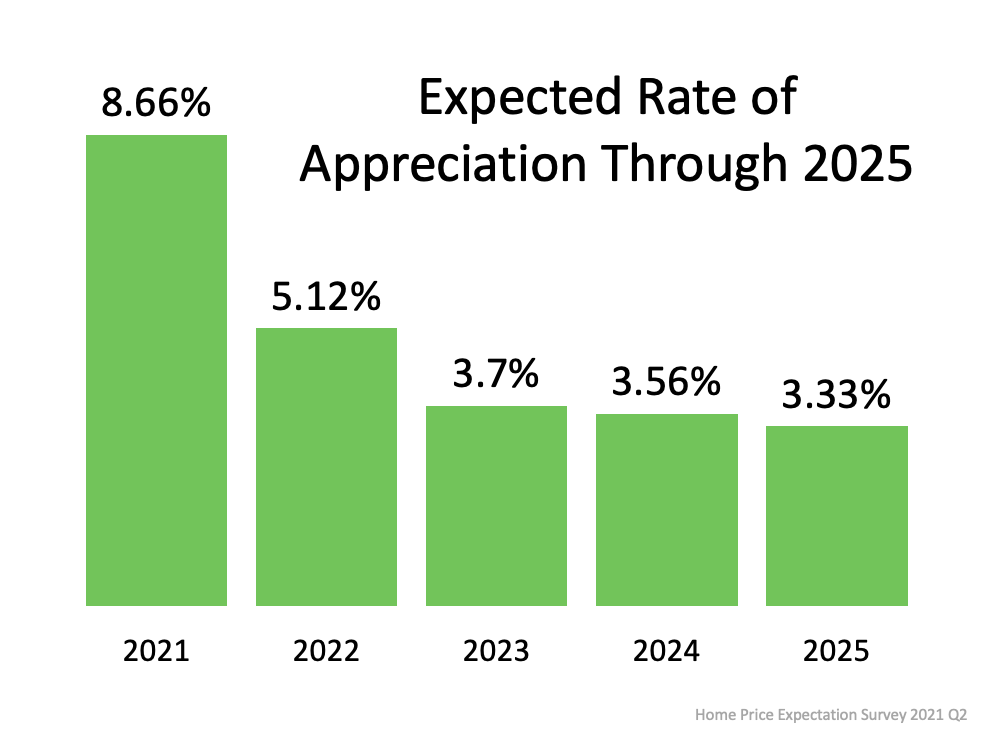
What Does This Mean for Homeowners?
Home prices are climbing today, and the data in the survey indicates they’ll continue to increase, but at rates that approach a more normal pace. Even still, the amount of household wealth a homeowner stands to earn going forward is substantial. This truly becomes clear when we consider a scenario using a median-priced home purchased in January of 2021 and the projected rate of appreciation on that home over the next five years. As the graph below illustrates, a homeowner could increase their net worth by a significant amount – over $93,000 dollars by 2026.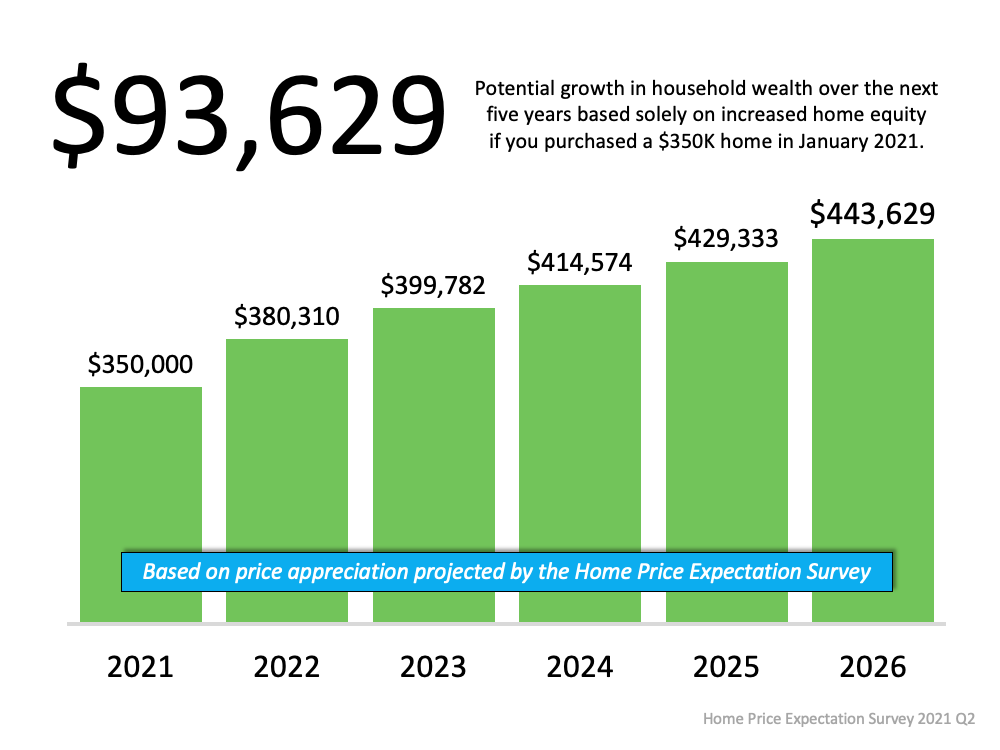
Home Price Appreciation and Home Equity
CoreLogic recently released their quarterly Homeowner Equity Insights Report, which tracks the year-over-year increases in equity. It shows an average annual gain of $33,400 per borrower over the past 12 months. In the report, Dr. Frank Nothaft, Chief Economist for CoreLogic, further explains:
“Double-digit home price growth in the past year has bolstered home equity to a record amount. The national CoreLogic Home Price Index recorded an 11.4% rise in the year through March 2021, leading to a $216,000 increase in the average amount of equity held by homeowners with a mortgage.”
The expected, sustained growth of home prices means homeowners can continue to build on the past year’s record levels of home equity – and their financial prosperity. It also presents today’s homeowners with a unique opportunity: using their growing equity for a home upgrade. With so few homes available to purchase and strong buyer demand, there may not be a better time to sell your current house and move into one that better meets your needs.
Bottom Line
Home prices are expected to continue appreciating over the next five years, and the associated equity gains are the quickest way homeowners can build household wealth. If you’re a current homeowner who’s ready to take advantage of your built-up equity, let’s connect today to discuss your options.
Powered by WPeMatico
Home Builders Ramp Up Construction Based on Demand

If you’re thinking of buying a home, there really is no time like the present. With today’s low mortgage rates, you have a great opportunity to get more home for your money. The challenge is inventory. Like you, many buyers want to capitalize on these market conditions, and it’s leading to more buyer competition and bidding wars.
If you’re having a hard time finding a home to buy, it may be time to talk to your trusted real estate advisor about a newly built home. Early indicators show new-home construction is beginning to ramp up. While new homes alone won’t be able to fix all of the inventory challenges, this does mean you’ll soon have more options as you search for a home. As a buyer, a newly built home may be exactly what you’re looking for – it’s brand new, and with builder customization options, it’s uniquely yours from the ground up.
Here’s what industry experts are saying about new homes coming to market:
Nadia Evangelou, Senior Economist and Director of Forecasting at the National Association of Realtors (NAR), says recent research could indicate upward momentum when it comes to new home construction. Evangelou refers to the volume of new homes where construction began during a set period, known in the industry as housing starts.
According to that research, housing starts reached their highest level since 2006 in March of this year – an encouraging sign for the industry. While they dipped slightly in April, Evangelou reiterates that the level of housing construction is heading in a positive direction compared to recent years:
“…we are currently building 24% more homes than we typically have built in April in the last couple of decades. Thus, housing construction is trending upward with housing starts likely to reach 1.6 million for all of 2021 and rise further to 1.7 million in 2022.”
As new data pours in, it further confirms this trend. According to the latest Monthly New Residential Construction report from the U.S. Census Bureau, housing starts increased even more in May, which continues the ongoing upward trend (see graph below) and indicates that ground is being broken on even more new homes.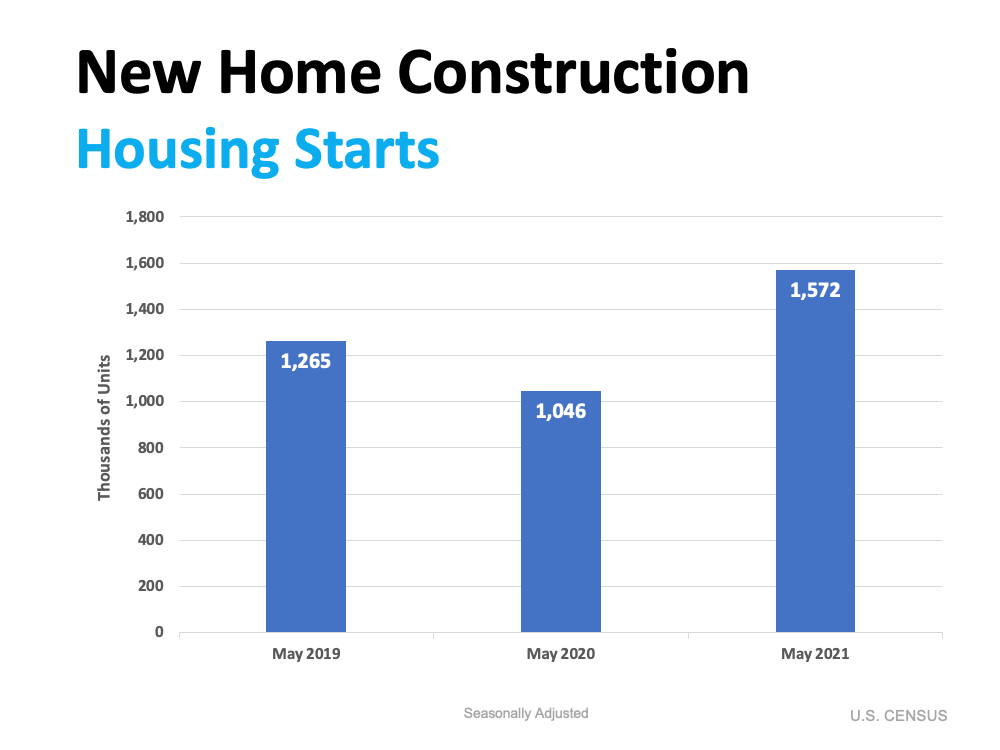 Robert Dietz, Chief Economist and Senior Vice President of Economics and Housing Policy for the National Association of Home Builders (NAHB), singles out another encouraging sign:
“It is also worth noting that the number of single-family homes permitted but not started construction continued to increase in May, rising to 142,000 units.”
This insight that there’s also an uptick in single-family homes permitted serves as an additional sign that more new homes lie ahead. It’s important to realize that the construction doesn’t have to start on these homes before you may be able to purchase one. According to the Monthly New Residential Sales report from the U.S. Census Bureau, many new homes are selling before construction even begins (see graph below):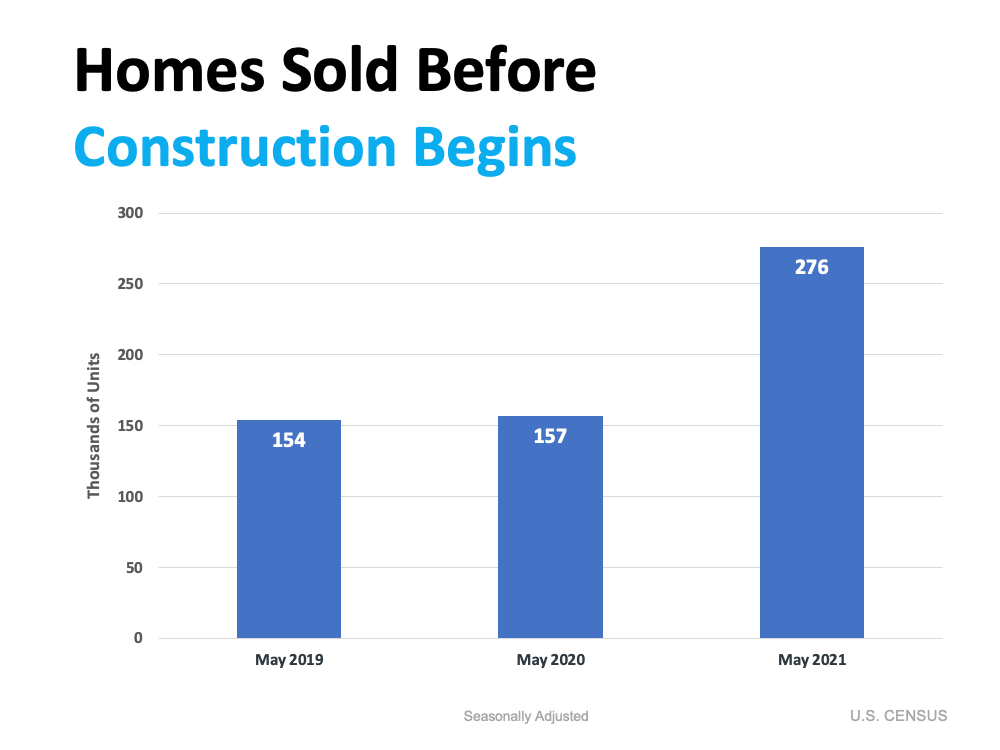 These signs are all good news for housing inventory. And as the recent challenges of rising lumber prices and dwindling lumber supply begin to improve, builders will be able to increase their production even more in the months ahead.
Bottom Line
While the inventory challenges we’re facing today won’t be solved overnight, the increase in new-home construction means your house may have more competition in the market. Let’s connect to talk about finding your dream home and the newly built homes available in our area.
Powered by WPeMatico


Are We in a Housing Bubble? Experts Say No.

The question of whether the real estate market is a bubble ready to pop seems to be dominating a lot of conversations – and everyone has an opinion. Yet, when it comes down to it, the opinions that carry the most weight are the ones based on experience and expertise.
Here are four expert opinions from professionals and organizations that have devoted their careers to giving great advice to the housing industry.
The Joint Center for Housing Studies in their The State of the Nation’s Housing 2021 report:
“… conditions today are quite different than in the early 2000s, particularly in terms of credit availability. The current climb in house prices instead reflects strong demand amid tight supply, helped along by record-low interest rates.”
Nathaniel Karp, Chief U.S. Economist at BBVA:
“The housing market is in line with fundamentals as interest rates are attractive and incomes are high due to fiscal stimulus, making debt servicing relatively affordable and allowing buyers to qualify for larger mortgages. Underwriting standards are still strong, so there is little risk of a bubble developing.”
Bill McBride of Calculated Risk:
“It’s not clear at all to me that things are going to slow down significantly in the near future. In 2005, I had a strong sense that the hot market would turn and that, when it turned, things would get very ugly. Today, I don’t have that sense at all, because all of the fundamentals are there. Demand will be high for a while, because Millennials need houses. Prices will keep rising for a while, because inventory is so low.”
Mark Fleming, Chief Economist at First American:
“Looking back at the bubble years, house prices exceeded house-buying power in 2006 nationally, but today house-buying power is nearly twice as high as the median sale price nationally…
Many find it hard to believe, but housing is actually undervalued in most markets and the gap between house-buying power and sale prices indicates there’s room for further house price growth in the months to come.”
Bottom Line
All four strongly believe that we’re not in a bubble and won’t see crashing home values as we did in 2008. And they’re not alone – Goldman Sachs, JP Morgan, Morgan Stanley, and Merrill Lynch share the same opinion.
Powered by WPeMatico
What Do Experts See on the Horizon for the Second Half of the Year?
As we move into the latter half of the year, questions about what’s to come are top of mind for buyers and sellers. Near record-low mortgage rates coupled with rising home price appreciation kicked off a robust housing market in the first half of 2021, but what does the forecast tell us about what’s on the horizon?
Mortgage Rates Will Likely Increase, but Remain Low
Many experts are projecting a rise in interest rates. The latest Quarterly Forecast from Freddie Mac states:
“We forecast that mortgage rates will continue to rise through the end of next year. We estimate the 30-year fixed mortgage rate will average 3.4% in the fourth quarter of 2021, rising to 3.8% in the fourth quarter of 2022.”
However, even as mortgage rates rise, the anticipated increase is expected to be modest at most, and still well below historical averages. Rates remaining low is good news for homebuyers who are looking to maximize their purchasing power. The same report from Freddie Mac goes on to say:
“While higher mortgage rates will help slow the pace of home sales and moderate house price growth, we expect overall housing market activity will remain robust. Our forecast has total home sales, the sum of new and existing home sales, at 7.1 million in 2021….”
Home Price Appreciation Will Continue, but Price Growth Will Likely Slow
Joe Seydl, Senior Markets Economist at J.P. Morgan, projects home prices to continue rising as well, indicating buyers interested in purchasing a home should do so sooner rather than later. Waiting for rates or home prices to fall may not be wise:
“Homebuyers—interest rates are still historically low, though they are inching up. Housing prices have spiked during the last six-to-nine months, but we don’t expect them to fall soon, and we believe they are more likely to keep rising. If you are looking to purchase a new home, conditions now may be better than 12 months hence.”
Other experts remain optimistic about home prices, too. The graph below highlights 2021 home price forecasts from multiple industry leaders: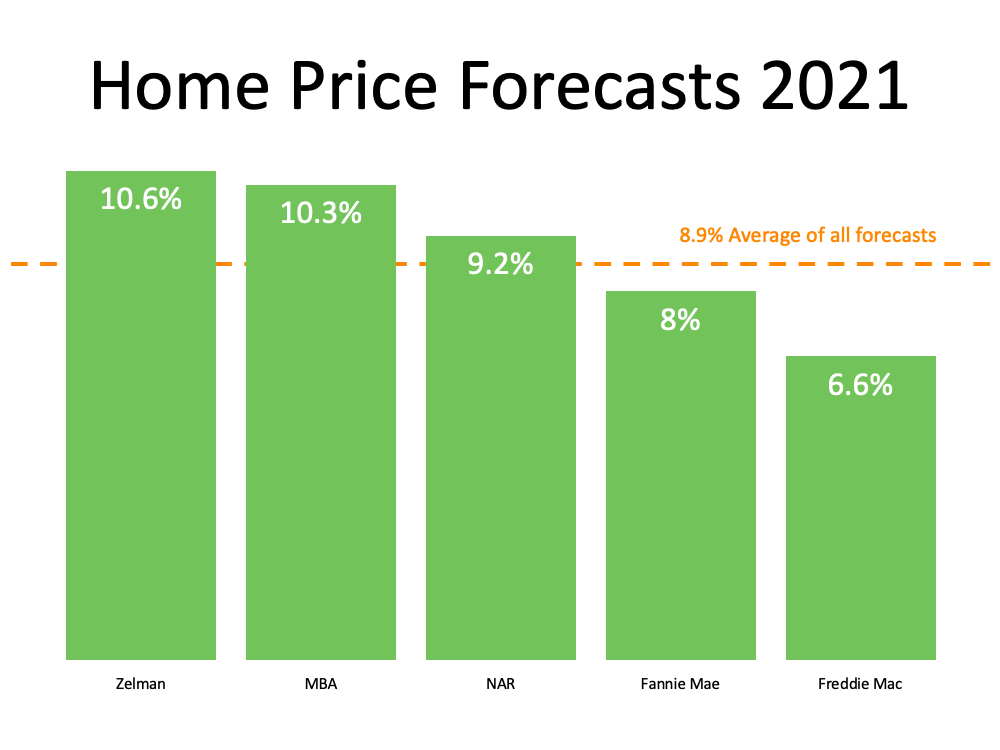
Inventory Remains a Challenge, but There’s Reason To Be Optimistic
Home prices are rising, but they should moderate as more housing inventory comes to market. George Ratiu, Senior Economist at realtor.com, notes there are signs that we may see the current inventory challenges lessen, slowing the fast-paced home price appreciation and creating more choices for buyers:
“We have seen more new listings this year compared with 2020 in 11 of the last 13 weeks. The influx of new sellers over the last couple of months has been especially helpful in slowing price gains.”
New home starts are also showing signs of improvement, which further bolsters hopes of more options coming to market. Robert Dietz, Chief Economist at the National Association of Home Builders (NAHB), writes:
“As an indicator of the economic impact of housing, there are now 652,000 single-family homes under construction. This is 28% higher than a year ago.”
Finally, while it may not fundamentally change the market conditions we’re currently experiencing, another reason to be optimistic more homes might come to market: our improving economy. Mark Fleming, Chief Economist at First American, notes:
“A growing economy in the summer months has multiple implications for the housing market. Growing consumer confidence, a stronger labor market, and higher wages bode well for housing demand. While a growing economy and improving public health conditions may also spur hesitant existing owners to list their homes for sale, it’s unlikely to significantly ease the super sellers’ market conditions.”
Bottom Line
As we look at the forecast for prices, interest rates, inventory, and home sales, experts remain optimistic about what’s on the horizon for the second half of 2021. Let’s connect today to discuss how we can navigate the market together in the coming months.
Powered by WPeMatico
What To Expect as Appraisal Gaps Grow

In today’s real estate market, low inventory and high demand are driving up home prices. As many as 54% of homes are getting offers over the listing price, based on the latest Realtors Confidence Index from the National Association of Realtors (NAR). Shawn Telford, Chief Appraiser at CoreLogic, elaborates:
“The frequency of buyers being willing to pay more than the market data supports is increasing.”
While this is great news for today’s sellers, it can be tricky to navigate if the price of your contract doesn’t match up with the appraisal for the house. It’s called an appraisal gap, and it’s happening more in today’s market than the norm.
According to recent data from CoreLogic, 19% of homes had their appraised value come in below the contract price in April of this year. That’s more than double the percentage in each of the two previous Aprils.
The chart below uses the latest insights from NAR’s Realtors Confidence Index to showcase how often an issue with an appraisal slowed or stalled the momentum of a house sale in May of this year compared to May of last year.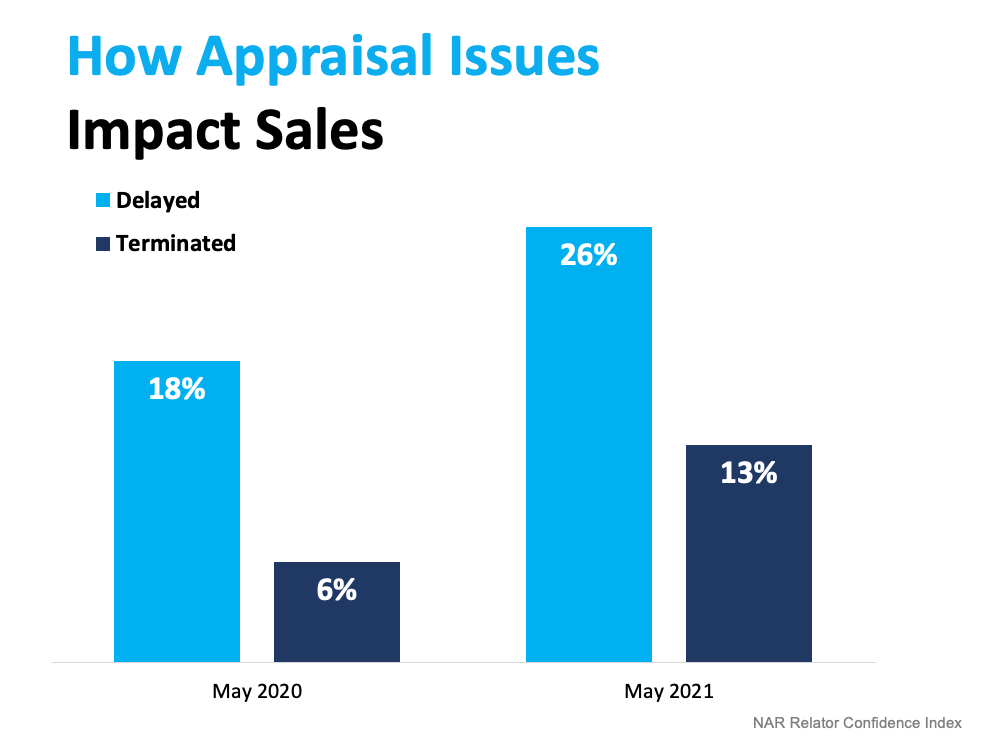 If an appraisal comes in below the contract price, the buyer’s lender won’t loan them more than the house’s appraised value. That means there’s going to be a gap between the amount of loan the buyer can secure and the contract price on the house.
In this situation, both the buyer and seller have a vested interest in making sure the sale moves forward with little to no delay. The seller will want to make sure the deal closes, and the buyer won’t want to risk losing the home. That’s why it’s common for sellers to ask the buyer to make up the difference themselves in today’s competitive market.
Bottom Line
Whether you’re buying or selling, let’s connect so you have an ally throughout the process to help you navigate the unexpected, including appraisal gaps.
Powered by WPeMatico
Save Time and Effort by Selling with an Agent

Selling a house is a time-consuming process – especially if you decide to do it on your own, known as a For Sale By Owner (FSBO). From conducting market research to reviewing legal documents, handling negotiations, and more, it’s an involved and highly detailed process that requires a lot of expertise to navigate effectively. That’s one of the reasons why the percentage of people selling their own house has declined from 19% to 8% (See graph below):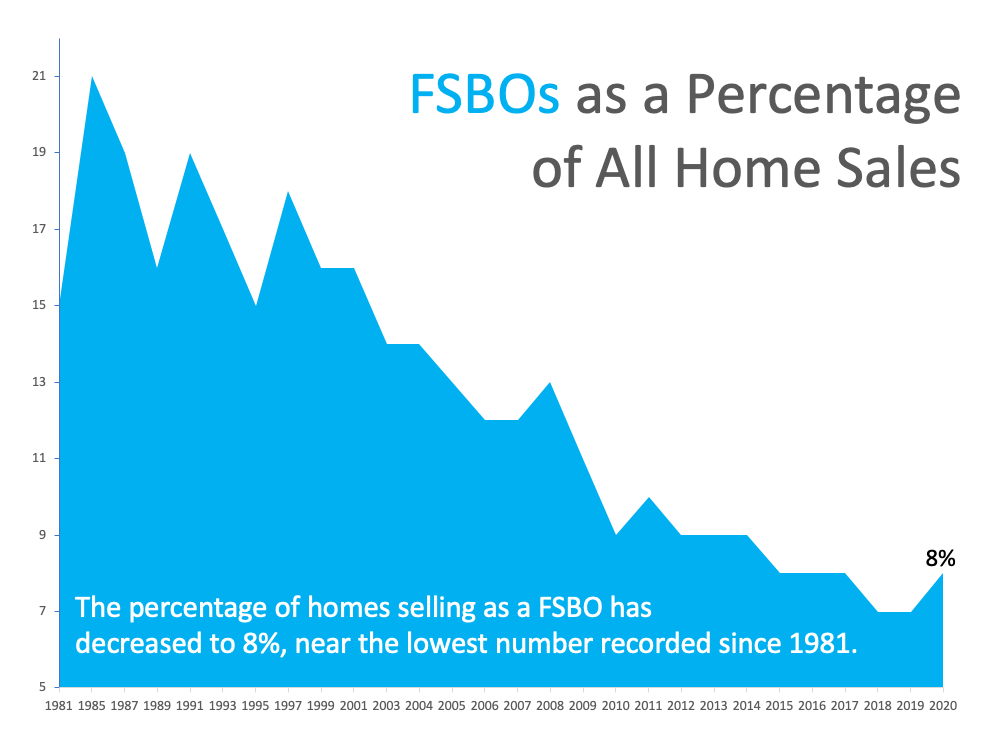 To help you understand just how much time and effort it takes to sell on your own, here’s a look at a few of the things you need to think about before putting that “For Sale” sign up in your yard.
1. Making a Good First Impression
While it may sound simple, there are a lot of proven best practices to consider when prepping a house for sale.
- Do you need to take down your personal art?
- What’s the right amount of landscaping to boost your curb appeal?
- What wall colors are most appealing to buyers?
If you do this work on your own, you may invest capital and many hours into the wrong things. Your time is money – don’t waste it. An agent can help steer you in the right direction based on current market conditions to save you time and effort. Since we’re in a hot sellers’ market, you don’t want to delay listing your house by focusing on things that won’t change your bottom line. These market conditions may not last, so lean on an agent to capitalize on today’s low inventory while you can.
2. Pricing It Right
Real estate professionals have mission-critical information on what sells and how to maximize your profit. They’re experienced when it comes to looking at recent comparable homes that have sold in your area and understanding what price is right for your neighborhood. They use that data to price your house appropriately, maximizing your return.
In a FSBO, you’re operating without this expertise, so you’ll have to do your own homework on how to set a price that’s appropriate for your area and the condition of your home. Even with your own research, you may not find the most up-to-date information and could risk setting a price that’s inaccurate or unrealistic. If you price your house too high, you could turn buyers away before they’re even in the front door, or run into problems when it comes time for the appraisal.
3. Maximizing Your Buyer Pool (and Profit)
Contrary to popular belief, FSBOs may actually net less profit than sellers who use an agent. One of the factors that can drive profit up is effective exposure. Simply put, real estate professionals can get your house in front of more buyers via their social media followers, agency resources, and proven sales strategies. The more buyers that view a home, the more likely a bidding war becomes. According to the National Association of Realtors (NAR), the average house for sale today gets 5 offers. Using an agent to boost your exposure may help boost your sale price too.
4. Navigating Negotiations
When it comes to selling your house as a FSBO, you’ll have to handle all of the negotiations. Here are just a few of the people you’ll work with:
- The buyer, who wants the best deal possible
- The buyer’s agent, who will use their expertise to advocate for the buyer
- The inspection company, which works for the buyer and will almost always find concerns with the house
- The appraiser, who assesses the property’s value to protect the lender
As part of their training, agents are taught how to negotiate every aspect of the real estate transaction and how to mediate potential snags that may pop up. When appraisals come in low and in countless other situations, they know what levers to pull, how to address the buyer and seller emotions that come with it, and when to ask for second opinions. Navigating all of this on your own takes time –a lot of it.
5. Juggling Legal Documentation
Speaking of time, consider how much free time you have to review the fine print. Just in terms of documentation, more disclosures and regulations are now mandatory. That means the stack of legal documents you need to handle as the seller is growing. It can be hard to know and truly understand all the terms and requirements. Instead of going at it alone, use an agent as your shield and advisor to help you avoid potential legal missteps.
Bottom Line
Selling your house on your own is a lot of responsibility. It’s time consuming and requires an immense amount of effort and expertise. Before you decide to sell your house yourself, let’s discuss your options so we can make sure you get the most out of the sale.
Powered by WPeMatico
Homebuyers: Hang in There [INFOGRAPHIC]
![Homebuyers: Hang in There [INFOGRAPHIC] | Simplifying The Market](https://iuseapro.com/wp-content/uploads/2021/06/20210625-KCM-Share-549x300-1.png)
![Homebuyers: Hang in There [INFOGRAPHIC] | Simplifying The Market](https://iuseapro.com/wp-content/uploads/2021/06/20210625-MEM.png)
Some Highlights
- Today’s sellers’ market provides unique challenges—and benefits—for buyers.
- Current low interest rates won’t last forever, and home prices are forecast to rise.
- If you’re a homebuyer, hang in there. Homeownership improves your quality of life, and the long-term benefits outweigh the short-term challenges.
Powered by WPeMatico
Demand for Vacation Homes Is Still Strong

The pandemic created a tremendous interest in vacation homes across the country. Throughout the last year, many people purchased second homes as a safe getaway from the challenges of the health crisis. With many professionals working from home and many students taking classes remotely, it made sense to see a migration away from cities and into counties with more vacation destinations.
The 2021 Vacation Home Counties Report from the National Association of Realtors (NAR) shows that this increase in vacation home sales continues in 2021. The report examines sales in counties where “vacant seasonal, occasional, or recreational use housing account for at least 20% of the housing stock” and compares that data to the overall residential market.
Their findings show:
- Vacation home sales rose by 16.4% to 310,600 in 2020, outpacing the 5.6% growth in total existing-home sales.
- Vacation home sales are up 57.2% year-over-year during January-April 2021 compared to the 20% year-over-year change in total existing-home sales.
- Home prices rose more in vacation home counties – the median existing price rose by 14.2% in vacation home counties, compared to 10.1% in non-vacation home counties.
This coincides with data released by Zelman & Associates on the increase in sales of second homes throughout the country last year.
As the data above shows, there is still high demand for second getaway homes in 2021 even as the pandemic winds down. While we may see a rise in second-home sellers as life returns to normal, ongoing low supply and high demand will continue to provide those sellers with a good return on their investment.
Bottom Line
If you’re one of the many people who purchased a vacation home during the pandemic, you’re likely wondering what this means for you. If you’re considering selling that home as life returns to normal, you have options. There are still plenty of buyers in the market. If, on the other hand, you want to keep your second home, enjoy it! Current market conditions show that it’s a good ongoing investment.
Powered by WPeMatico